Building Bilingual Digital Products for European Markets
What actually changes when a product needs to work equally well in two languages — and what mechanical translation misses.
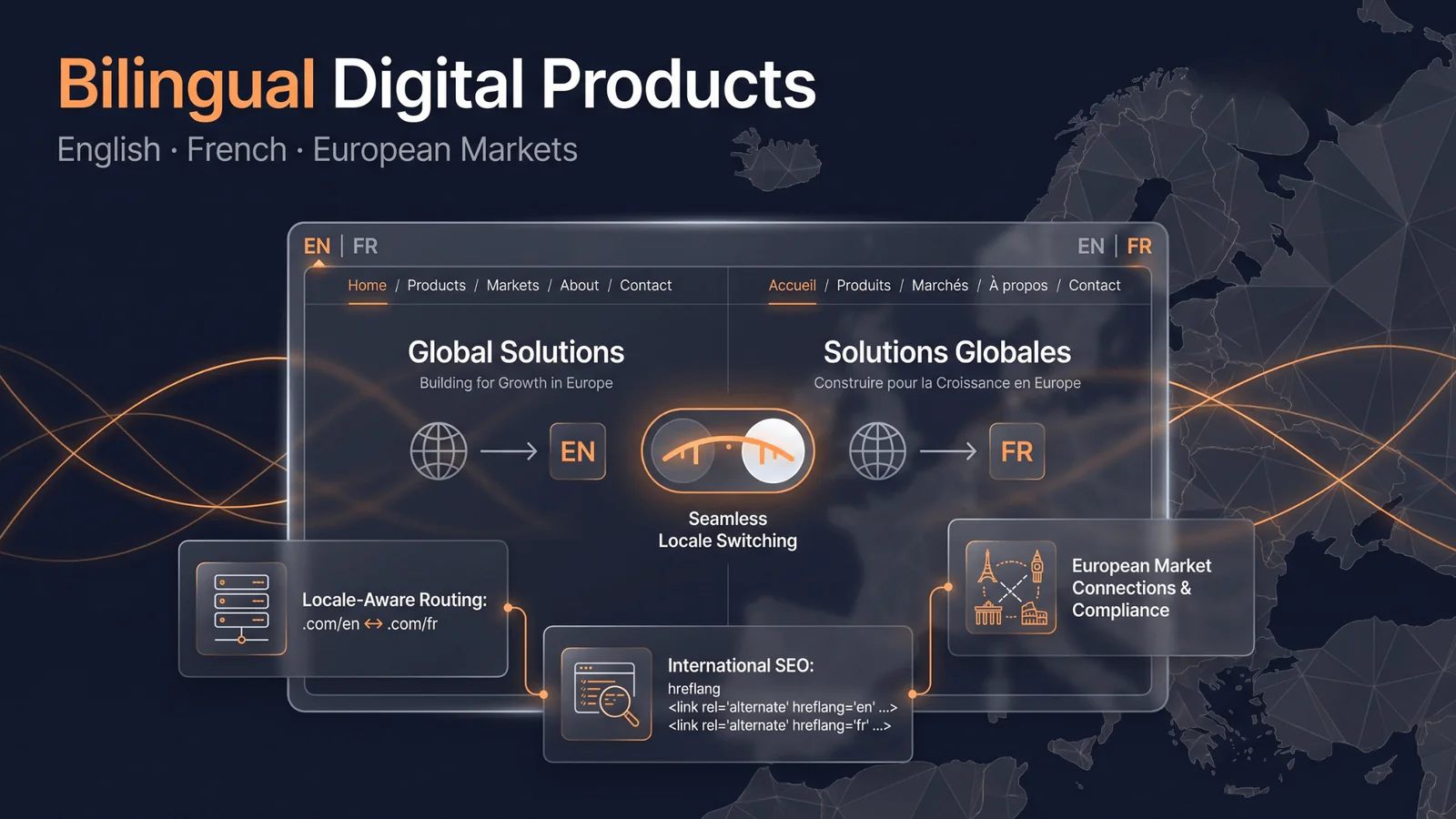
A bilingual product is not a monolingual product with a translated copy of every string. Treated that way, it usually shows in the details — SEO, tone, even routing.
Routing and SEO need a real strategy, not an afterthought
Duplicate content across languages without proper hreflang tagging actively hurts search visibility instead of helping it. Every page needs a clear canonical URL, correct alternate-language links, and locale-specific metadata — not just translated body copy sitting under the same tags as the original.
Mechanical translation reads like mechanical translation
Recruiters and clients in French-speaking markets notice tone as much as accuracy. A literal translation of an English sentence structure often reads stiffly in French, even when every word is technically correct — professional French needs its own sentence rhythm, not a word-for-word mirror.
- Keep technology and brand names untranslated — translating "React" or "Next.js" helps no one.
- Write each language's marketing copy with its own voice, not as a translation pass on the other.
- Test the language switcher on every page type, including dynamic ones — it's the first thing a bilingual visitor tries.
The read-aloud test
If a French sentence sounds odd read aloud by a French speaker, it's probably a literal translation rather than a native rewrite — worth fixing even if a translation tool would call it "correct."
The takeaway
A genuinely bilingual product treats each language as a first-class version of the site, not a translated layer over one canonical version — that shows up in routing, SEO, and simply in how natural the copy sounds to a native reader.
Does this topic connect with a product or challenge in your team?
Let’s discuss your product needs, architecture or workflows.
